



Kite Info
Scientific Discoveries Using Kites – Part 2
From aerial mapping to wind energy generation, kites have powered scientific breakthroughs for centuries. Part 2 of Fly360's deep dive into kite science and discovery.
Kites are perhaps the most underrated scientific instrument in human history. In Part 1 we covered Benjamin Franklin and the Wright Brothers. In Part 2 we go deeper: bridge construction across Niagara, man-carrying kites, Alexander Graham Bell’s tetrahedral inventions, ancient Polynesian fishing techniques, and the aerodynamic lineage that leads all the way to Olympic kite surfing.
How a 10-Year-Old’s Kite Built the Niagara Falls Bridge
In 1847, engineer Charles Ellet faced an impossible challenge: get the first cable across the Niagara Gorge. A kite-flying contest provided the answer. Ten-year-old Homan Walsh flew his kite across the gorge, establishing the first link between the cliffs. After his line snapped on ice and a second attempt succeeded, progressively heavier cables were pulled across until a steel cable connected the cliffs — enabling construction of the world’s first railway suspension bridge. The prize money Walsh earned was the most literal example in history of a kite earning its keep.
Alexander Graham Bell’s Tetrahedral Kite: The Phone Man Who Flew
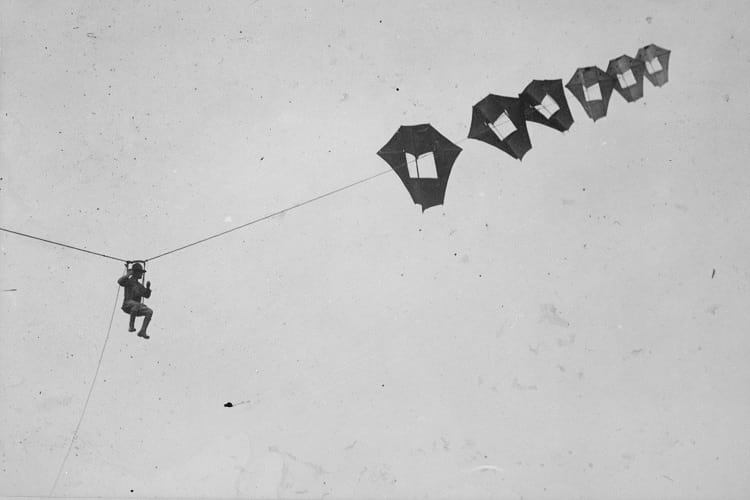
Alexander Graham Bell is remembered for the telephone. Less known is his parallel obsession: a kite strong enough to carry a human. Bell designed the tetrahedral kite — built from triangular cells forming the strongest geometric form in nature. His 1907 Cygnet kite, comprising 3,393 tetrahedral cells, successfully carried a man aloft. Bell’s work directly advanced understanding of rigid lightweight structures — the same engineering principles that underpin modern aerospace frame design.
Kite Fishing: Ancient Polynesian Precision Aerial Technique
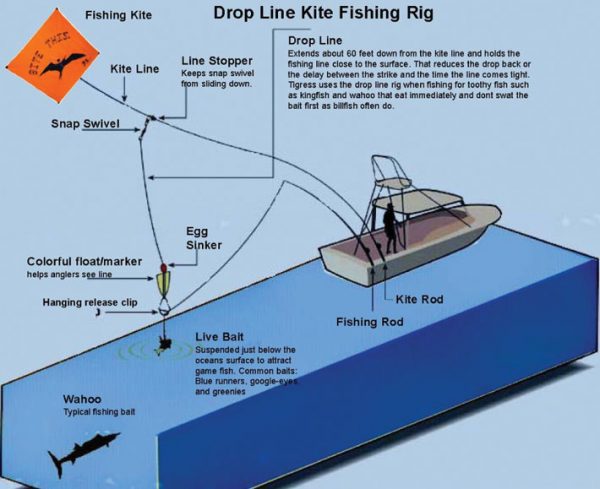
Long before satellite navigation, Polynesian fishermen used kites to place lures precisely over reef fish in coastal shallows — areas too shallow for a canoe to approach without disturbing the catch. The kite held the line taut at a precise angle, delivering bait with minimal surface disturbance. The technique spread across Pacific island cultures and remains in use in Papua New Guinea today. It represents one of the earliest examples of a tool used as a precision delivery mechanism.
Kite Surfing: Where Discovery Meets Olympic Sport
The line from scientific kite experiments to modern kite surfing is direct. The aerodynamic principles studied by Bell and the Wright Brothers — lift coefficients, angle of attack, wind pressure — are what allow a kite surfer to harness 8 to 16 metres of canopy to accelerate across water at speeds above 50 km/h. Kite surfing became an Olympic sport in 2024. It is, in essence, applied kite science — the final act of 2,000 years of discovery, performed at the water’s edge.

Fly360: Building on 2,000 Years of Kite Engineering
At Fly360, every kite begins as an engineering problem. Director Nisarg Shah — Limca Book of Records holder and recipient of appreciation from former President Dr. A.P.J. Abdul Kalam for his aerospace-themed Pushpak Space Shuttle kite design — treats kite fabrication with the same rigour as aerospace component design. Industrial ripstop nylon, carbon fibre spars, fiberglass reinforcements, and 3D-printed connectors designed in AutoCAD ensure every Fly360 kite performs precisely as calculated. The science of kites has never stopped evolving — and neither have we.
Gallery

Frequently Asked Questions
How was a kite used to build the Niagara Falls bridge?In 1847, a boy named Homan Walsh flew a kite across the Niagara Gorge to establish the first line between the cliffs. Progressively heavier cables were then pulled across using the kite line, enabling construction of the world's first railway suspension bridge over Niagara.Did Alexander Graham Bell build a man-carrying kite?Yes. Bell's tetrahedral kite, built from thousands of triangular cells, was designed to be the strongest lightweight structure possible. His Cygnet kite successfully carried a man aloft in 1907, advancing knowledge of rigid lightweight engineering.What is kite fishing?Kite fishing is an ancient Polynesian technique using a kite to hold a fishing line at a precise angle over coastal reef fish. This delivers bait without the disturbance of a canoe. It is still practised in Papua New Guinea today.What scientific principles make a kite fly?Kites fly due to aerodynamic lift — wind flowing over the curved kite surface creates lower pressure above and higher pressure below, generating upward force. A tail and bridle system stabilise the angle of attack for stable flight.How does Fly360 apply kite science in its designs?Fly360 uses industrial ripstop nylon, carbon fibre spars, fiberglass reinforcements, and 3D-printed AutoCAD-designed connectors to build kites engineered to perform precisely under calculated wind conditions — applying the same principles kite scientists have refined for 2,000 years.