


How Does a Kite Stay Up in the Air? The Physics Explained
In December 1907, Alexander Graham Bell’s Cygnet, a kite built from 3,393 tiny tetrahedral cells, lifted a man 168 feet above the water. No engine. No flapping wings. Just wind, string and physics.
That same physics holds a paper kite over an Ahmedabad rooftop on Uttarayan. So how does a kite stay up in the air? Kites have been tools of science for centuries, and the way they work is more elegant than most people expect.
In this article
A kite stays up because moving air hits its tilted sail and is pushed downward, and the air pushes back. That upward push is called lift. The kite hangs in the sky when lift, drag, weight and line tension balance. The string does not hold the kite up. It holds the kite back.
How does a kite stay up in the air? Four forces in balance
Every flying kite is a small, quiet argument between four forces. NASA’s Glenn Research Center lists them as weight, line tension and the aerodynamic force, which splits into lift and drag.
- Weight pulls the kite down. The sail, spars, tail and the bit of line it carries all count.
- Lift acts at right angles to the wind. It is the force that fights weight.
- Drag acts in the direction the wind is blowing. It tries to shove the kite downwind.
- Line tension pulls the kite back toward your hand. It has a vertical part (Pv) and a horizontal part (Ph).

In steady flight nothing is accelerating, which is Newton’s first law at work. NASA writes the balance as two simple sums: vertically, lift equals weight plus the downward pull of the line (Pv), and horizontally, drag equals the horizontal pull of the line (Ph).
Look closely at that first sum. The line pulls the kite down as well as back. Lift does all the holding up. The string only stops the wind from carrying your kite to the next village.
| Force | Direction | What increases it |
|---|---|---|
| Lift | Perpendicular to the wind, upward | Faster wind, larger sail, a well-trimmed angle |
| Drag | Along the wind, downwind | Faster wind, larger sail, a steeper angle, a tail |
| Weight | Straight down | Heavier frame, sail, tail and line |
| Line tension | Along the line, toward the flyer | Stronger wind, bigger kite, a steeper kite |
Where does a kite’s lift come from?
Tilt a flat sail into moving air and two things happen at once. The sail forces the air to turn downward. By Newton’s third law, the air pushes the sail upward. The angle between the sail and the oncoming wind is called the angle of attack.
The pressure story says the same thing from another side. Air flowing past a tilted sail leaves lower pressure above it and higher pressure below. Add up that pressure difference over the whole sail and you get the same upward force.

Newton or Bernoulli? Both are right
Classrooms love to say that air travels farther over the top of a wing, so it must go faster to “catch up” with the air below. NASA’s Tom Benson calls that equal transit time idea wrong. The real airflow over the top is much faster than that explanation predicts.
“So both ‘Bernoulli’ and ‘Newton’ are correct.”
NASA Glenn Research Center, on explaining lift
A kite sail is often a flat sheet, not a curved wing, which proves the point. A flat plate tilted into the wind makes lift with no longer path over the top at all.
Why wind speed matters: the lift equation
Lift grows with wind speed faster than most people guess. NASA gives the lift equation as:
Because wind speed is squared, doubling the wind quadruples the lift. Doubling the sail area only doubles it. That is why a small kite that sags at 10 km/h can pull hard at 20 km/h.

Most single-line kites are happiest in a light to moderate breeze, roughly Beaufort force 2 to 4. Below that, lift is too weak. Above force 5 (31 km/h and up), lift and line tension climb quickly and only strong kites and experienced hands should be out.
No wind? Make your own
NASA is clear that what matters is the relative velocity between the air and the kite. Run, and you create relative wind. Pull the line, and you add to it. Bell’s Cygnet was towed behind a motorboat for exactly this reason: the boat supplied the breeze.
Why kites climb to find steady wind
Near the ground, wind is slow and gusty because buildings, trees and the surface itself drag on the air. Higher up, it speeds up and smooths out. NASA puts it plainly: with enough altitude, the velocity, and the lift force with it, become fairly constant.
The standard wind profile power law shows how much that is worth. Over flat open coast, wind at 100 m blows about 45% faster than wind at 10 m. Since lift tracks wind speed squared, that is roughly twice the lift per square metre of sail. Over inhabited areas the exponent is higher (0.34 against 0.16), so the gain from climbing is even bigger.


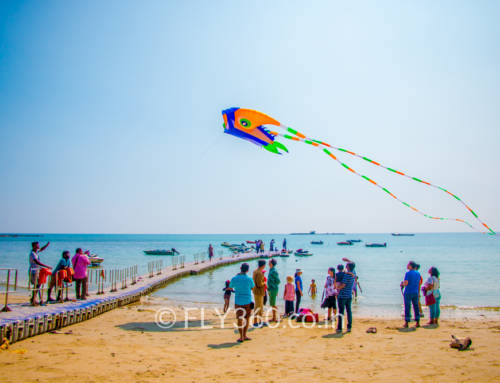
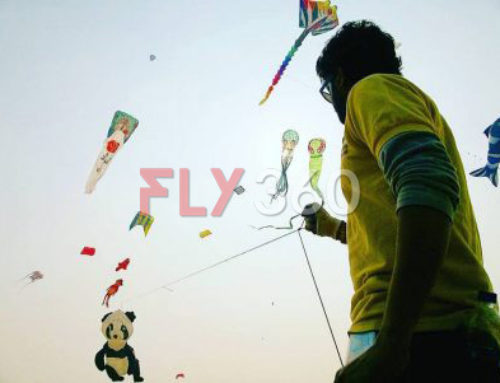
Open beaches, such as Vengurla in Maharashtra, give kites smooth air with little to break the wind.
The bridle, the trim angle and the tail
Where the line attaches matters enormously. The kite pivots about its bridle point, and NASA notes that the location of that point has a major effect on performance. The angle where all the twisting forces cancel is the trim angle. A kite is stable if it returns to that angle after a disturbance.
- Too flat: the angle of attack is small, lift is weak and the kite sags.
- Well trimmed: lift comfortably beats weight and the kite climbs and holds.
- Too steep: the airflow separates from the sail. This is a stall. Lift drops, drag rises and the kite wobbles or dives.

A tail adds a little weight and drag behind the sail. That pulls the kite’s nose back into the wind and calms wobbles, the way feathers steady an arrow.
What happens in a gust, and when the wind dies?
- A gust arrives: lift and drag both jump. Lift exceeds weight plus the downward line pull, so the kite rises and line tension increases until a new balance is found.
- The wind drops: lift falls below weight and the kite sinks. Run, or pull the line, to restore relative airflow and you can pull it back up.
- You let out line: the kite climbs into faster, steadier wind. Letting out too much makes the line heavier and sags the kite slightly.
The same physics, from a 1.5-inch kite to 1,150 kites on one line
At Fly360, we live inside these equations. They decide which fabric we cut, which spars we pick and how much a night-show battery is allowed to weigh.
At the small end, Nisarg Shah won First Prize from Prime Minister Narendra Modi at the Gujarat International Kite Festival for a fully working kite just 1.5 inches across. At that size, every milligram of frame eats into lift, so the weight budget is merciless.
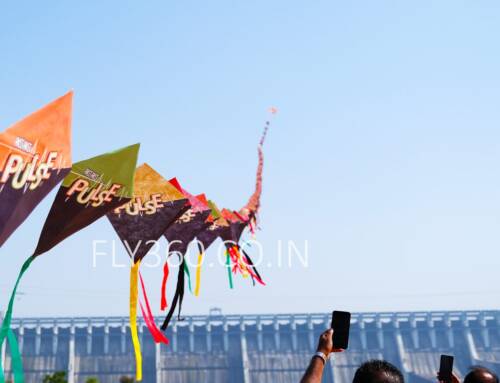
At the large end, the Fly360 team flew 1,150 custom kites on a single 1,155 m line for the #PulseOfTheSky campaign, a Limca Book of Records entry set in Gujarat during Uttarayan. Ten Fly360 flyers handled the line. Each kite added lift and drag, and the tension grew toward the flyer’s end because that stretch of line carried the drag of every kite beyond it.


Materials follow the physics too. Our sails are ripstop nylon, and our frames use fibreglass spars with carbon fibre reinforcement where loads peak. Light, stiff and tough is the only recipe that keeps weight low and lift high.
Night shows raise the stakes. In our LED night kite shows, the lights, wiring and lithium cells all add weight, so the lift has to beat them as well. It is why we model and test before any kite goes up after dark.

A Fly360 LED night kite show. The lights have to be lighter than the lift they cost.
From the Sabarmati Riverfront in Ahmedabad to the Andaman Islands and the Mauritius International Kite Festival, the sky follows the same four rules.
Kites taught the world to fly
Wilbur Wright’s first recorded aeronautical experiment, in 1899, was a biplane kite roughly six feet across. Four control lines let him twist its wings to test whether a pilot could roll an aircraft. The Wrights later used that idea, wing warping, on their gliders and powered aircraft.
Try it yourself: three quick experiments
- Feel the lift. Stand a safe distance in front of a guarded pedestal fan on its lowest setting. Hold a stiff A4 card flat and edge-on to the air, then tilt the front edge up a little. You will feel it pushed up and back: lift and drag.
- Find the stall. Keep tilting the card steeper. At some point the push turns shuddery and mostly backward. That is the airflow separating.
- Chase the steady wind. Next time you fly, note how the kite behaves just above the rooftops, then let out line. Watch it settle as it climbs into cleaner air.
Kite physics glossary
- Lift
- The part of the air’s force on the kite that acts at right angles to the wind. It holds the kite up.
- Drag
- The part of the air’s force that acts along the wind. It pushes the kite downwind.
- Angle of attack
- The angle between the sail and the oncoming air.
- Bridle
- The strings that connect the sail to the flying line. Where they meet is the bridle point.
- Trim angle
- The angle at which the twisting forces on the kite cancel out.
- Stall
- Loss of lift when the airflow separates from the sail because the angle is too steep.
Frequently asked questions about how kites stay up
How does a kite stay up in the air?
A kite stays up because wind hits its tilted sail and is deflected downward. The air pushes back on the sail, and that upward push is called lift. The kite hangs in the sky when lift, drag, weight and line tension are in balance. The string does not hold the kite up. It holds the kite back against the wind.
What are the four forces acting on a kite?
The four forces on a kite are lift, drag, weight and line tension. Lift acts at right angles to the wind and holds the kite up. Drag acts along the wind and pushes the kite downwind. Weight pulls the kite down. Line tension pulls the kite back toward the flyer. In steady flight, lift equals weight plus the downward pull of the line, and drag equals the horizontal pull of the line.
Why do kites need wind to fly?
Kites need moving air because lift depends on the speed of the air relative to the kite. Lift grows with the square of that speed, so doubling the wind quadruples the lift. If there is no natural wind, you can create relative wind by running or pulling the line, as Alexander Graham Bell did in 1907 by towing his Cygnet kite behind a motorboat.
Does Bernoulli’s principle explain how a kite flies?
Yes, but it is only half the story, and the popular equal transit time explanation is wrong. NASA explains that both Bernoulli and Newton are correct. Pressure is lower above a tilted sail and higher below it, and the sail also turns the air downward, so the air pushes the sail up. Both descriptions give the same lift force.
Why does a kite fly better when you let out more string?
Wind speed increases with height, and the air higher up is steadier than the gusty air near the ground. Over flat open coast, wind at 100 metres is about 45 percent faster than at 10 metres, which is roughly twice the lift per square metre of sail. Letting out line lets the kite climb into faster, smoother wind.
Why do kites have tails?
A tail adds a little weight and drag behind the sail. This pulls the kite’s nose back into the wind and calms wobbling, much like the feathers on an arrow. The tail also gives you a visual cue to see how the kite is behaving in the air.
What is the best wind speed for flying a kite?
Most single-line kites fly best in a light to moderate breeze, roughly Beaufort force 2 to 4, which the Met Office lists as 7 to 30 km/h. Below that range there is too little lift. From Beaufort force 5, 31 km/h and above, lift and line tension rise quickly and only strong kites and experienced flyers should be out.
What is angle of attack on a kite?
Angle of attack is the angle between the kite’s sail and the oncoming wind. If it is too small, the kite makes little lift and sags. If it is too steep, the airflow separates from the sail in a stall, lift drops and drag rises. Sliding the bridle knot changes this angle.
Build a kite, then watch the four forces work
Book a kite making workshop for your school, camp, team or birthday party. Every participant builds a kite, trims it and flies it, and we bring everything. Want something one of a kind? We design and print custom kites too.

Keep reading
- NASA Glenn Research Center, Forces on a Kite
- NASA Glenn Research Center, Kite Flight
- NASA Glenn Research Center, Kite Trim and Bridle Point
- NASA Glenn Research Center, Incorrect Lift Theory: Equal Transit Time
- NASA Glenn Research Center, The Lift Equation
- Met Office, Beaufort Wind Force Scale
- Wikipedia, Wind gradient (power law exponents)
- Wikipedia, AEA Cygnet
- Wright Brothers Aeroplane Company, The 1899 Kite
Leave A Comment