How to Host a Kite Festival in India: Fly360’s Complete Expert Guide
Expert guide to hosting a kite festival in India by Fly360: venue, wind, safety, kite programme, food and crowd engagement. 700+ events experience.
A well-run kite festival is one of the most visually spectacular events you can host. A poorly planned one is a logistical disaster with tangled lines, unsafe crowds, and disappointed attendees. The difference lies in preparation. Fly360, India’s leading professional kite event company with 700+ events delivered across 4 continents, shares its complete operational blueprint for hosting a kite festival that your audience will talk about for years.
Whether you are an event planner, a tourism board, a corporate team, or a community organiser, this guide covers every element of kite festival planning from venue selection to post-event content strategy.
Step 1: Choosing the Right Venue for a Kite Festival
The most critical decision in kite festival planning is the venue. Get this wrong and no amount of preparation can rescue the event. The right venue for a kite festival has:
- ✓ Open sky with no tall obstructions within 200 metres: trees, buildings, and power lines all create wind turbulence that makes flying dangerous
- ✓ Consistent wind from a single predictable direction: check historical wind data for the site, not just a single day’s forecast
- ✓ Ground space of at least 200 by 200 metres for a medium-scale event (5,000+ spectators require proportionally more)
- ✓ Crowd management infrastructure: entry and exit routes, barriers, signage
- ✓ Parking and basic facilities: toilets, water points, first aid station
- ✓ Power access for LED night kite shows (if included)
Beaches, riverbronts, open sports grounds, and hilltops consistently provide the best combination of wind conditions and crowd capacity. Fly360 conducts a formal site assessment before every festival it organises.
Step 2: Planning the Kite Programme – What Will Fly?
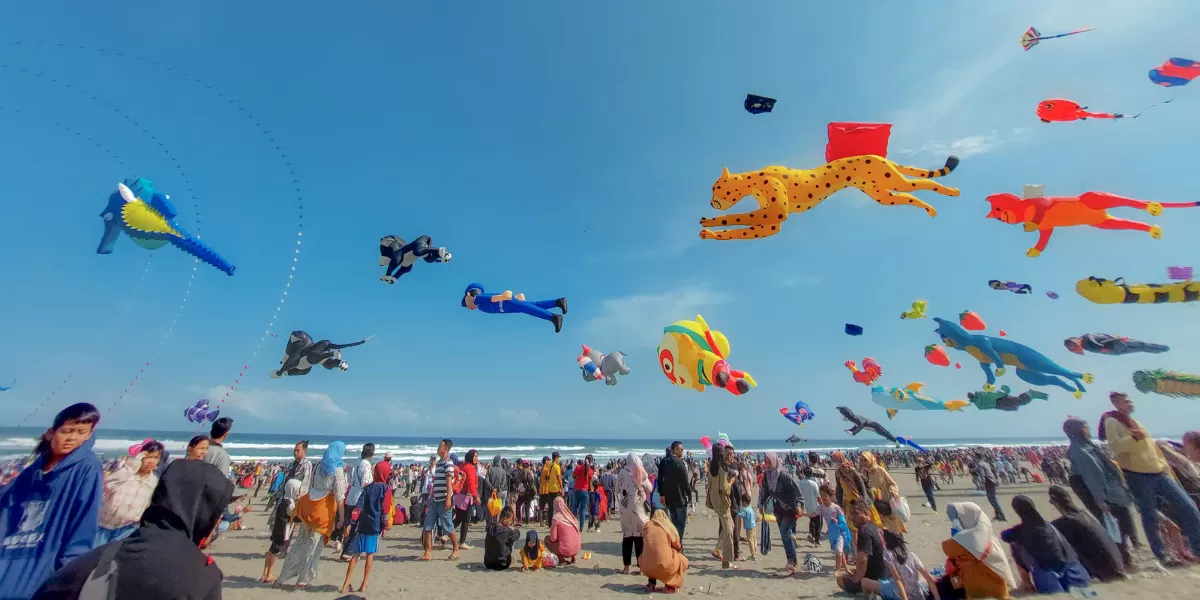
The kite programme is the heart of the festival. It should have structure, progression, and variety. A typical Fly360 festival programme follows this sequence:
- ✓ Opening display: designer kites launched progressively to build visual impact as the crowd gathers
- ✓ Competition flying: if included, run simultaneous competitive events in defined zones away from the spectator area
- ✓ Workshop sessions: scheduled kite making workshops that give attendees an active role rather than passive observation
- ✓ LED night show: if the event extends past sunset, an LED kite show provides a natural visual finale that produces exceptional photography and social media content
Every element of the programme needs a defined duration, a clear zone on the site map, and a named person responsible for execution.
Step 3: Safety Protocols for Kite Festivals
Safety is non-negotiable at a kite festival. The most common incidents are line tangles that cause kites to dive into crowds, and spectators straying into flying zones. Both are preventable with proper planning.
- ✓ Flying zones must be physically separated from spectator zones using barriers or ropes
- ✓ All kite lines above 100 feet must be routed away from spectator pathways
- ✓ Manja (glass-coated kite string) must be prohibited: it causes severe injuries to birds and people
- ✓ Wind speed must be monitored throughout the event: above 35 kmph, large kites should be grounded
- ✓ First aid station must be staffed and accessible from all areas of the venue
- ✓ Communication plan: how will the team communicate if an incident requires immediate response?
Fly360 has a formal safety protocol for every event it manages. The team has never had a serious safety incident across 700+ events.
Step 4: Custom Kites – Why They Transform the Festival Experience
The difference between a kite festival with standard commercial kites and one with custom Fly360 designer kites is the difference between a local car show and a motor racing event. Custom kites create the visual moments that make people reach for their phones, share what they see, and come back the following year.
For a festival with a specific theme or sponsor, custom printed kites carry the event branding at 300 feet. Fly360 designs and manufactures custom kites from its workshop, with UV-resistant printing on industrial ripstop nylon and engineered structures that fly stably in the specific wind conditions of your site.
Step 5: Food, Music, and Atmosphere
A kite festival is a community event, not just an aerial display. The atmosphere on the ground determines whether attendees stay for the full day or leave after the first hour.
- ✓ Food vendors: variety is more important than volume. Local festival food alongside family-friendly options
- ✓ Seating: both designated seating areas and informal grass viewing areas
- ✓ Music: ambient or live music creates energy without competing with the spectacle in the sky
- ✓ Lighting and decor: kite-themed decorations and festival lighting, especially for evening events
- ✓ Social media activation: a custom hashtag, a photo point with the event branding, and encouragement for attendees to share
Frequently Asked Questions: How to Host a Kite Festival
Common questions answered by the Fly360 team.
How much does it cost to organise a kite festival?
What is the ideal wind speed for a kite festival?
How far in advance should I plan a kite festival?
Can Fly360 manage the entire kite festival for us?
Do I need permission to hold a kite festival?
Ready to Plan Your Kite Festival?
Share your event brief with Fly360 and the team will design the right aerial experience for your audience.