Why Brands Are Moving Ad Budgets to the Sky: Aerial Advertising in the Age of Digital Ad Fatigue
Digital advertisers are cutting display ad spend by roughly 30% in 2026 as screen attention drops to 47 seconds and consumers check phones over 200 times a day. In response, brands are reinvesting in offline, experiential channels — and aerial advertising through custom-engineered branded kites has emerged as one of the most cost-effective, unmissable formats available, particularly in markets like India where domestic manufacturing keeps quality high and costs low.
The Screen Stopped Working
For two decades, digital advertising operated on a simple assumption: if you can get in front of someone’s screen often enough, you can build a brand.
That assumption is breaking down.
Average screen-based attention has fallen to roughly 47 seconds, and people check their phones around 205 times a day- once every five minutes. Audiences aren’t just scrolling past ads anymore; they’ve developed what researchers call active resistance to them, not passive fatigue. The result, according to Forrester’s 2026 predictions for B2C marketing, is that advertisers are expected to cut display ad budgets by close to 30% as consumers leave the open web altogether.
This isn’t a temporary dip. It’s a structural correction. Brands spent fifteen years chasing impressions on channels that audiences have learned to tune out, block, or actively avoid. The money has to go somewhere else.
It’s going outdoors.
Why Experiential and Offline Marketing Is Winning Budget Back
A joint study from the ANA and The Harris Poll found that seven in ten marketers are planning increased investment in physical, real-world touch points as digital saturation accelerates. The reasoning is straightforward: a billboard, a live activation, or a branded object in physical space doesn’t compete with a mute button, an ad blocker, or a thumb mid-scroll.
What makes this moment interesting for brands and agencies is timing. Content Marketing Institute data shows that only one in five B2B marketers consider their experiential marketing programs “established” – the category is still in its early build phase. Most competitors are still figuring out the basics. That’s a meaningful head start for any brand willing to move first.
Out-of-home formats are seeing the clearest benefit. Industry coverage of 2026 ad spend shifts points to billboards, branded environments, and live brand activations gaining ground specifically because digital trust and attention have eroded at the same time, leaving a vacuum that traditional and experiential offline formats are filling.
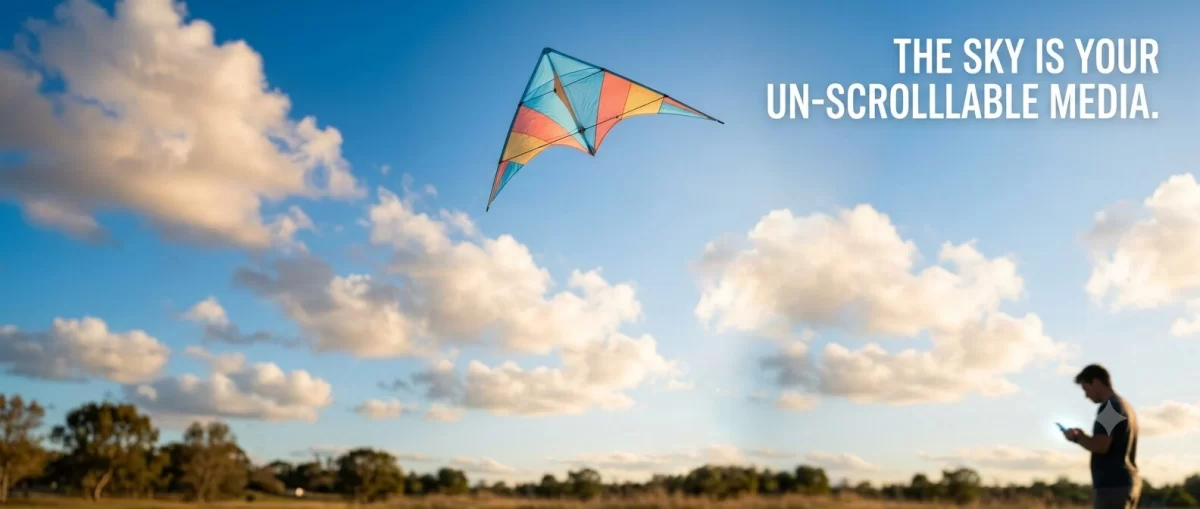
Aerial advertising sits squarely inside this shift – and it has an advantage most OOH formats don’t: it can’t be ignored by accident, and it can’t be physically blocked.
What Is Aerial Advertising, and Why Kites Specifically?
Aerial advertising covers any branding executed in open sky space – banners towed by aircraft, drone light shows, skywriting, and custom-shaped branded kites. Each format has a different cost structure, regulatory profile, and visual impact.
Custom-engineered kites occupy a specific niche inside that category: high visual impact, lower regulatory friction than drones or aircraft in most jurisdictions, and a production cost that scales with creative ambition rather than flight-hour billing.
A well-engineered branded kite isn’t a craft object. It’s a structural design problem. A 12×12-foot custom delta kite carrying a brand logo at altitude has to account for wind load tolerances, material fatigue, line tension, and weight distribution – the same category of engineering thinking that goes into any outdoor structure exposed to variable conditions. That’s the difference between a kite that holds a brand’s shape cleanly for six hours at a beach festival and one that collapses after twenty minutes.
This is also where most aerial activations fail. Treating a branded kite as a one-off novelty item rather than an engineered product – is why so many brand activations underdeliver. FLY360 has approached this from the manufacturing side since 1996, as India’s first and, to date, only domestic manufacturer of custom designer-shaped kites; nearly every other kite supplier serving Indian events imports from China, which limits both customization and quality control.
Off-Season Is the Opportunity, Not the Obstacle
Most marketers assume kite-based campaigns only make sense around Makar Sankranti or other traditional kite-flying festivals. That assumption is backwards.
When everyone is flying kites during peak season, a branded kite is one of dozens in the sky. When a brand flies during the off-season – a product launch, a tourism push, a corporate event in a month nobody associates with kites – there is no competing visual noise. The brand owns the entire sky, not a fraction of it.
This mirrors a broader pattern in experiential marketing: distinctiveness compounds when a format is deployed where competitors aren’t looking, not where they already are.
The Credibility Question: Does Aerial Kite Branding Actually Work?
Any new media format invites a fair question: is this proven, or is it a gimmick?
Three data points are worth weighing:
Cross-demographic appeal. Kites carry almost no negative cultural association across age groups, regions, or income levels – a rarity in modern marketing, where most formats (influencer content, programmatic display, even traditional OOH in saturated markets) carry some baseline audience fatigue or skepticism.
Manufacturing track record. FLY360 has completed more than 700 large-scale aerial events across four continents, served over 500 enterprise clients, and produced more than 100,000 custom-engineered kites since formalizing commercial operations. The brand holds two Limca Book of Records entries – for flying 1,150 custom kites simultaneously on a single 1.2-kilometer line, and for conducting a kite-engineering workshop for 1,017 participants in one sitting.
Institutional validation. FLY360’s work has earned a First Prize from Prime Minister Narendra Modi at the Gujarat International Kite Festival, a Letter of Appreciation from former President Dr. A.P.J. Abdul Kalam, permanent exhibits in the World Kite Museums of Washington D.C. and Istanbul, and a commission from Duracell Inc. for a cinematic television campaign. Most recently, a custom India-Germany collaboration kite designed by FLY360 was flown by PM Modi and German Chancellor Friedrich Merz at the Ahmedabad International Kite Festival in January 2026.
None of that happens with a craft-store kite. It happens with engineering discipline applied to an underused medium.
How Brands Are Using Aerial Kite Campaigns in 2026
- Product launches and tourism campaigns: Large custom shapes – brand mascots, logos, inflatable figures – flown over high-footfall beach or festival locations for sustained visual exposure across a full day rather than a 15-second ad slot.
- Civic and government campaigns: Structured, compliant, large-scale public engagement work, including past collaborations with national institutional bodies, where message clarity and public trust matter as much as visual scale.
- Night activations: LED-integrated kites using lithium power configurations for after-dark visibility at festivals and corporate events, extending brand exposure beyond daylight hours.
- Cross-border and diplomatic moments: Custom international-collaboration kites designed for joint appearances at major kite festivals, where the design itself carries diplomatic and cultural symbolism alongside brand value.
Frequently Asked Questions
Is aerial advertising legal in India? Most forms of aerial advertising – including custom kite displays at festivals, beaches, and private or government-sanctioned events – operate within standard event permissions. Drone-based aerial advertising carries additional aviation authority requirements; kite-based aerial branding generally does not face the same regulatory complexity, which is part of why it has scaled faster across Indian markets.
How is a branded kite different from a regular kite? A branded kite is engineered to a brand’s exact specifications – custom shape, size, color accuracy, and structural reinforcement to hold its form and message clearly at altitude for extended periods, often in 12×12-foot or larger formats. This requires CAD-based structural design and material selection (ripstop nylon, fiberglass or carbon-fiber spars), not off-the-shelf kite construction.
Does kite advertising only work during kite festival season? No – off-season campaigns are often more effective because there is no competing visual activity in the sky, meaning a single brand’s activation receives undivided attention rather than competing with dozens of other kites during peak season.
What makes Indian-manufactured kites different from imported ones? Domestic manufacturing allows for tighter design iteration, custom shape fabrication (rather than fixed templates), in-house quality control, and faster turnaround – advantages that matter most for time-sensitive corporate or government campaigns. FLY360 has operated as India’s only domestic designer-kite manufacturer since 1996.
What size and scale can a custom advertising kite reach? Custom kites can range from small promotional pieces to large-format structures exceeding 12×12 feet, and can be flown individually or as coordinated multi-kite trains – FLY360 has engineered formations of over 1,000 kites flown simultaneously on a single line.
The Bottom Line
Digital advertising isn’t disappearing, but its monopoly on marketing budgets is ending. The brands gaining ground in 2026 are the ones treating physical, real-world presence as infrastructure rather than an afterthought – and the sky remains one of the least saturated, most universally well-received spaces left to occupy.
For brands evaluating where the next campaign budget should go, the question worth asking isn’t whether offline experiential formats work. The data already answers that. The real question is which offline format earns attention without earning resentment – and few do that as reliably as something flying, in full color, against open sky.
FLY360 has designed, manufactured, and flown custom branded kites for corporates, government bodies, and global brands since 1996, completing 700+ events across four continents. To discuss a custom aerial activation, contact our team.
Your Content Goes Here