


Home / Blog / Indian Kite
Indian Kite
Reviving Kite Flying – The Ancient Art
Kite flying is a 2,000-year-old art form experiencing a global commercial revival. Discover how FLY360 is engineering that revival — one sky-scale activation at a time.
Reviving Kite Flying: The Ancient Art the World Never Actually Forgot
A string in your hand. A 12-square-foot delta structure pulling hard against a 25 km/h headwind. A corporate logo visible from 400 metres away.
That is not nostalgia. That is aerial engineering and it is the reason the global kite equipment market is tracking toward USD 2.5 billion by 2032.
Kite flying is one of the oldest continuously practised human technologies on the planet. Written records trace active kite use to 206 BC in China. Within the Indian subcontinent, references appear in 13th-century devotional poetry, in Mughal-era administrative records, and in the Ramcharitmanas, where Tulsidas describes Rama flying a kite called a chagg all the way to Indralok. The tradition did not need reviving. It needed re-engineering for a world that had forgotten what it was actually capable of.
2,000 Years of Aerodynamic Intent
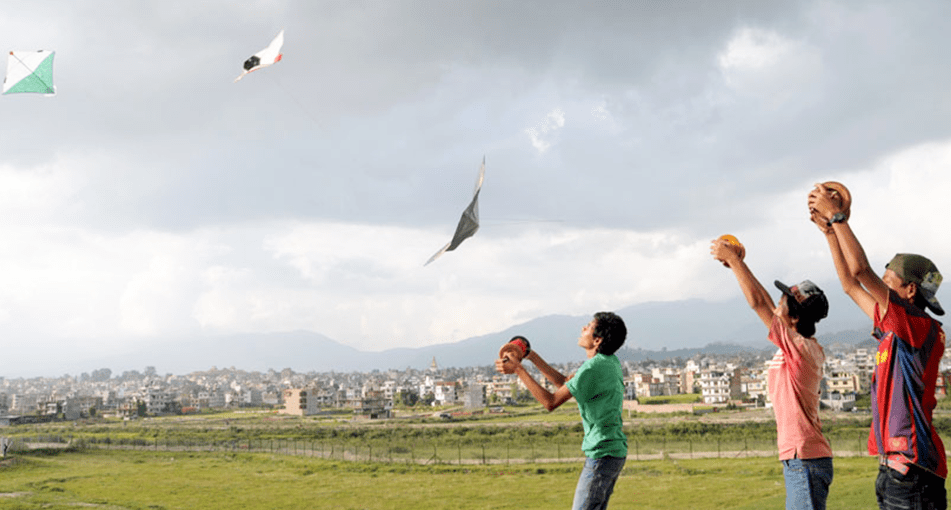
The popular narrative positions kite flying as a festival pastime, a seasonal softness reserved for Makar Sankranti rooftops and the cry of Kai Po Che! across Gujarat’s winter sky. That framing is real and it is also wildly incomplete.
Kites have been instruments of military calculation, cultural diplomacy, and civic ritual for two millennia. The Chinese general Han Hsin reportedly used a kite to calculate the precise tunnel length needed to breach a fortified city wall in 169 BC. Mughal court records document kite flying as a competitive sport among the nobility, with designs refined specifically for aerodynamic superiority. The tradition arrived in Gujarat not as a folk hobby but as a court-level discipline.
Makar Sankranti which marks the sun’s northward transit into Capricorn, the astronomical event called Uttarayan formalised kite flying as a civic annual event across western and northern India. The act of flying a kite skyward was understood as a symbolic acknowledgment of the sun’s return, a way of directing collective attention upward. Communities spent hours on rooftops, sustained vitamin D exposure built into the ritual’s structure without anyone calling it a health intervention.
That is the lineage. Not decoration. Intent.
Why the Global Revival Is Actually a Recognition
In 2024, the global kitesurf boards and kites market was valued at approximately USD 780 million. Forecasts project that figure reaching USD 1.4 billion by 2033 at a 6.8% CAGR. The kiteboarding equipment segment alone – just one vertical within the broader kite economy – is valued at USD 1.12 billion in 2025, expected to reach USD 2.3 billion by 2035.
These numbers reflect something beyond sport. They reflect a recognition, accelerating in the post-pandemic period, that wind-powered aerial systems – whether for recreation, brand activation, or spectacle – have a structural advantage no ground-level medium can replicate: they are impossible to ignore.
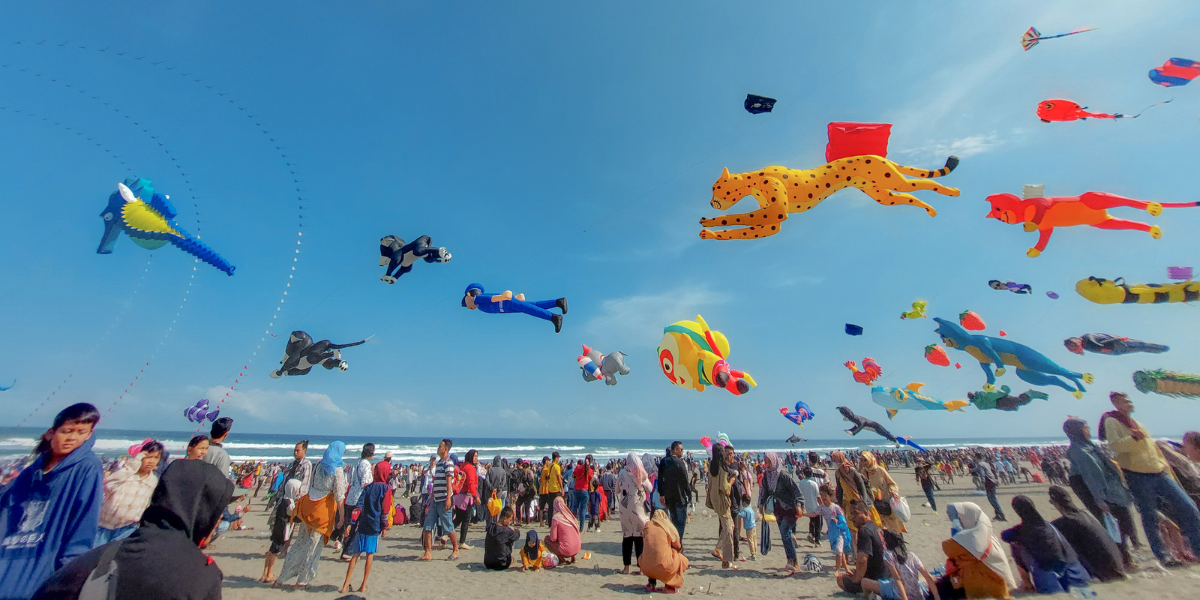
A 12×12-foot branded delta kite flying at 80 metres altitude generates what no billboard, pop-up, or projection screen produces: organic sky presence. Every camera within a 500-metre radius points upward. Crowds self-organise around the spectacle. The content generates itself.
This is not new information. Festival organisers, state governments, and enterprise brands have known it for years. What has changed is the engineering infrastructure to deliver it at scale, with reliability, and on deadline.
From Festival Ground to Commercial Sky: The FLY360 Model
FLY360 began as a generational craft formalised in practice as early as 1996, scaled into a structured commercial entity in 2017. The founding thesis was precise: kite flying’s cultural authority was unmatched, but its commercial potential was being forfeited because no operator was engineering it like an infrastructure project.
That gap became the business.
Today, FLY360 deploys heavy-load custom kite structures including 12×12-foot branded deltas, large-format inflatable aerial figures, traditional Malaysian Wau kites, and multi-unit train networks carrying hundreds of branded panels simultaneously. Every structural component that does not commercially exist is designed in AutoCAD, modelled for aerodynamic load, and produced in-house on industrial 3D printers using ASA filament for UV stabilisation, Nylon for tensile strength under gust loads, and PETG for structural connectors.
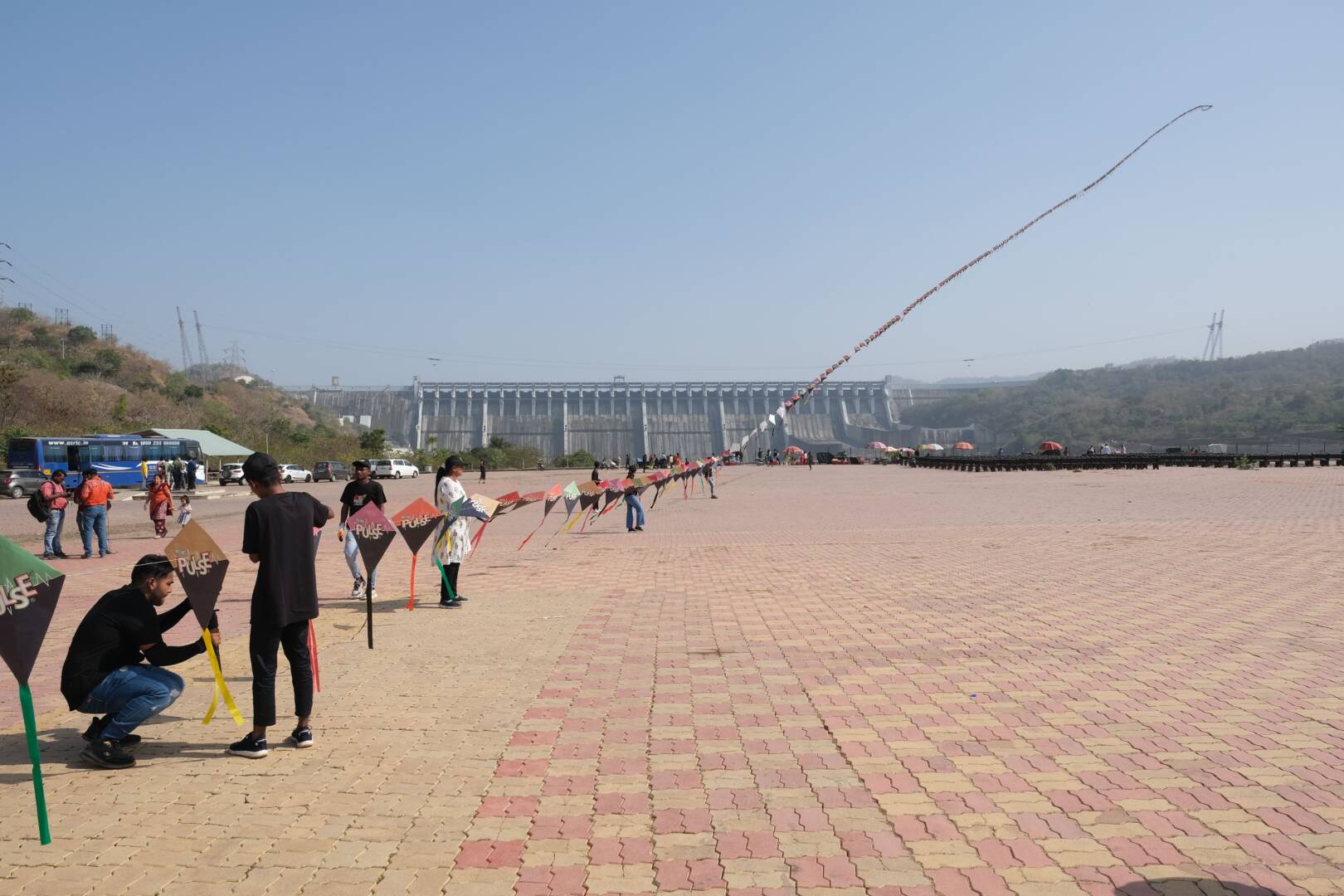
The most technically demanding of these builds was the #PulseOfTheSky campaign for DS Group’s Pass Pass Pulse brand: 1,150 custom-engineered kites flown simultaneously on a single, continuous 1.2-kilometre line. That single-line formation now a Limca Book of Records entry required sub-millimetre connector engineering, staged wind-load calculations across the full 1.2-km span, and real-time tension management at launch. It is not a stunt. It is a structural engineering problem solved in the sky.
A second Limca record followed: a kite-making and aerodynamics workshop conducted for 1,017 participants simultaneously in a single sitting the logistics of which required the same project management discipline as a large-scale corporate training deployment.
The Evidence That Validates the Form
The credibility of a commercial aerial platform is only as strong as its most demanding clients.
FLY360 has received a First Prize from Prime Minister Narendra Modi at the Gujarat International Kite Festival awarded for engineering and successfully flying a fully functional 1.5-inch ultra-miniature kite. The same attention to tolerance engineering that produced a 1.5-inch flying structure is what produces a reliable 12-foot branded delta at a corporate product launch.
A Letter of Appreciation from President Dr. A.P.J. Abdul Kalam acknowledged the aerospace-themed “Pushpak Space Shuttle” custom design an aeronautical reference point that is not incidental. Dr. Kalam’s recognition of a kite as an aerospace artefact is precisely the framing this medium deserves.
Beyond national recognition: FLY360 kites are in permanent collection at the World Kite Museum in Washington D.C.and a kite museum in Istanbul two cities that operate the most rigorous curatorial standards in the discipline globally.
Over 700 large-scale aerial events. Four continents. 500+ enterprise corporate clients. 1,00,000+ custom-engineered kites manufactured. The geographic scope spans India, the UAE, Spain, Turkey, Mauritius, and Uganda.
The Ancient Art Is Not Coming Back. It Never Left.
The narrative of “reviving” kite flying contains a false premise. You do not revive what has never stopped.
Every January across Gujarat, Rajasthan, Maharashtra, and Delhi, millions of people take to rooftops and open grounds without any prompting from a heritage board or a cultural revival campaign. The International Kite Festival in Ahmedabad, launched in 1989, draws kite fliers and audiences from across the world and has, on at least one documented occasion, served as the venue for a custom India-Germany collaboration kite flown in the presence of both the Prime Minister of India and the German Chancellor.
What is changing is the infrastructure around the form. Industrial ripstop nylon has replaced bamboo-tensioned tissue where structural reliability requires it. Carbon fibre composites and fiberglass spars have expanded the feasible scale of single-kite structures by an order of magnitude. Bespoke LED electronics and high-efficiency lithium power systems have extended the operating envelope to nighttime opening an entirely new sky-space that no ground-level event medium can compete with after dark.
The ancient art is not being revived. It is being scaled.
What This Means for Brands, Event Organisers, and Cultural Institutions
The sky is the only advertising medium that is simultaneously unmissable, photograph-worthy, and culturally legitimate.
A kite above your event is not a prop. It is a 2,000-year-old symbol of aspiration, civic celebration, and aerodynamic precision now available in your brand’s exact Pantone specification, flying at a load-calculated altitude, documented for content production.
FLY360 designs, engineers, manufactures, and operates every element of that system in-house. From the initial AutoCAD structural brief to the 3D-printed connector tolerances, from the wind-load model to the on-site flight crew the entire delivery chain sits within one organisation.
If your event, campaign, or institutional brief requires a sky-level presence that no ground-based medium can produce, the engineering infrastructure for it already exists.
It has existed, in various forms, for over two thousand years.
FLY360 Precision engineering enables reliable, repeatable awe.
Explore our aerial event capabilities at fly360.co.in